
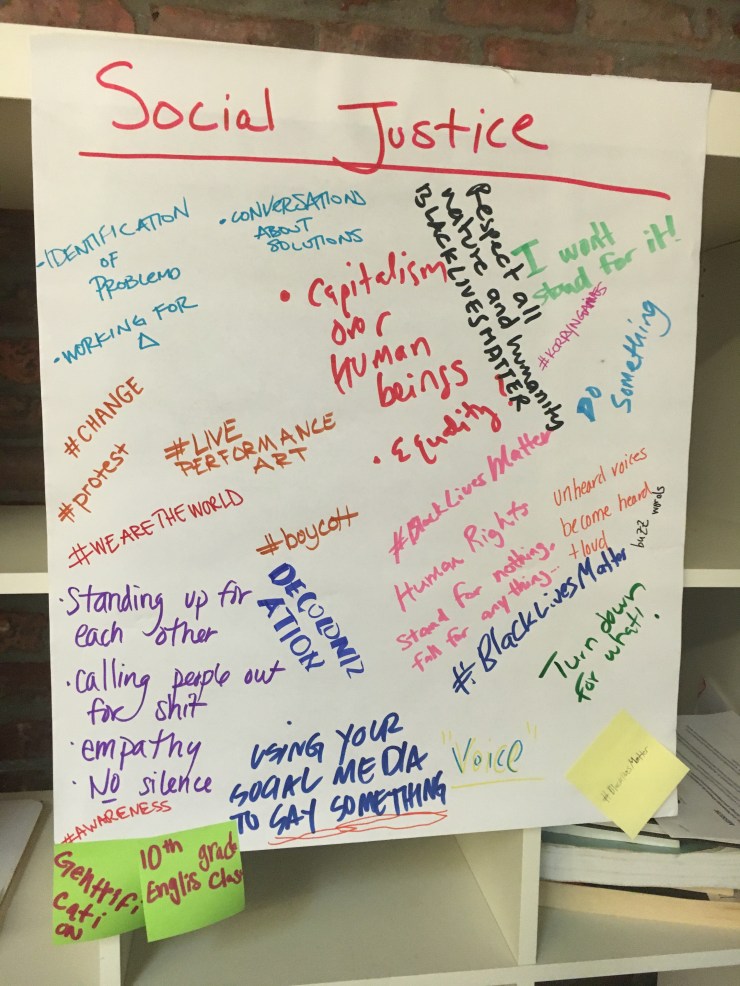
I was raised by non-profit organizations holding on for survival as governments and foundations played with our future deciding which cause was worthy of their funding in renewed grant cycles. I’ve written in other articles how these organizations shaped my life, gave me knowledge of self, purpose and clear direction. They deeply supported young people’s points of view in the world and our decisions to speak out for what we believed in. Once, we developed a theater piece that pulled the flag in a circle as we battled for freedom. In the rehearsal the flag ripped and became a way to visually show how we felt about our country- broken. We chose to have that be part of the piece, the flag would be ripped and we were supported in our decision.
Recently, the nonprofit arts organization I work for has been suffering. Not for lack of funding but with fear of taking a strong stance to speak out about social and racial justice issues as we neared the inauguration of Donald Trump.
Interviewing for a job this past month I asked- given our current political landscape, if young people in your program choose to take a stance against the president’s policies would you stand with them? And their answer was that nonprofits cannot be political. They can however provide a platform to have multiple people share their points of view.
My work is at a critical turning point, what does the next 4 years for me look like in Trump’s America? How can I be true to my morals and values if I cannot take a side in the face of a government that enforces structural violence, racism, misogyny, patriarchy…?
I find my recent work being criticized as pushing a specific social justice agenda by people who do not understand what social justice is. My work is rooted in ensuring basic human rights, I tell them but they say we can’t take sides. What does it mean then, with our current political climate to take a side and not be neutral? What is the risk to call out racism? Or any other form of oppression and structural violence we will undoubtedly experience in the era of Trump?
Racism, as Ruth Gilmore describes is rooted in the ways groups of people are “vulnerable to premature death” whether at the hands of the state or structures that kill. To me this is a matter of people living and dying or existing somewhere in between. In Jeff Chang’s “We Gon’ Be Alright” he writes the death of Blacks is over 50 percent higher than that of whites, and higher than that of all major ethnic groups, except for some American Indian cohorts (pg4)” Social justice is about people’s right to live a full life without being fettered by systems put in place to stifle their growth.
When presented with this brief information illustrating a fraction of what our country’s current condition is, adding the imminent policies of Trump that ravage anything from LGBTQ, Immigrant, and women’s rights, and environmental justice where is the duty for nonprofits to speak up?
We are what the government uses to funnel civic duties they do not want to take on as their own. It is our job to support civic engagement, to support people in our communities and in our schools. Specifically working for an organization whose mission is to close the achievement gap- how do we do that without a clear analysis and plan for racial justice? We cannot pretend that this is not at the center of our fight when there are clear numbers that point to it.
Mastery of critical race analysis should be the primary skillset of every nonprofit leader in urban cities to start, but really should be a skill set for leaders everywhere. The more I work for social justice I experience a range of distaste for this work by white nonprofit leaders, from a blind disregard to a refusal to acknowledge the problem.
The NYT ran an article before the Women’s March titled “Women’s March on Washington Opens Contentious Dialogues about Race” where a white woman cannot understand what “checking her privilege” means and how she would no longer be participating because the march has become too much about telling white women to step back and be quiet for women of color to speak. Critical race analysis gives people the tools to understand the need to make space for women of color who have traditionally been shut out of decision making, leadership, jobs, fair pay and voting far much longer.
I understand that I need to work everyday to better understand my positionality as it relates to my identity as a Peruvian-Italian, cis-women, daughter/granddaughter of immigrants with a good amount of white privilege. Most of the time people misidentify our analysis problem. When examining oppression it is not about blaming the individual for what their ancestors have done. It is necessary however for white individuals specifically, to do the work to understand the repercussions of how their actions perpetuate the system. It’s up to them to analyze their life experiences versus those around them and begin dismantling the invisible structures they sit comfortably in. We need to dismantle it all and know that this will require great discomfort. If you’re not in the process dismantling it, of examining history, who you are and how you contribute to this crazy world as it exists today you are not doing work responsibly.
 Augustina Warton